Can A Sewer Camera Find Every Blockage Cause In Calgary?
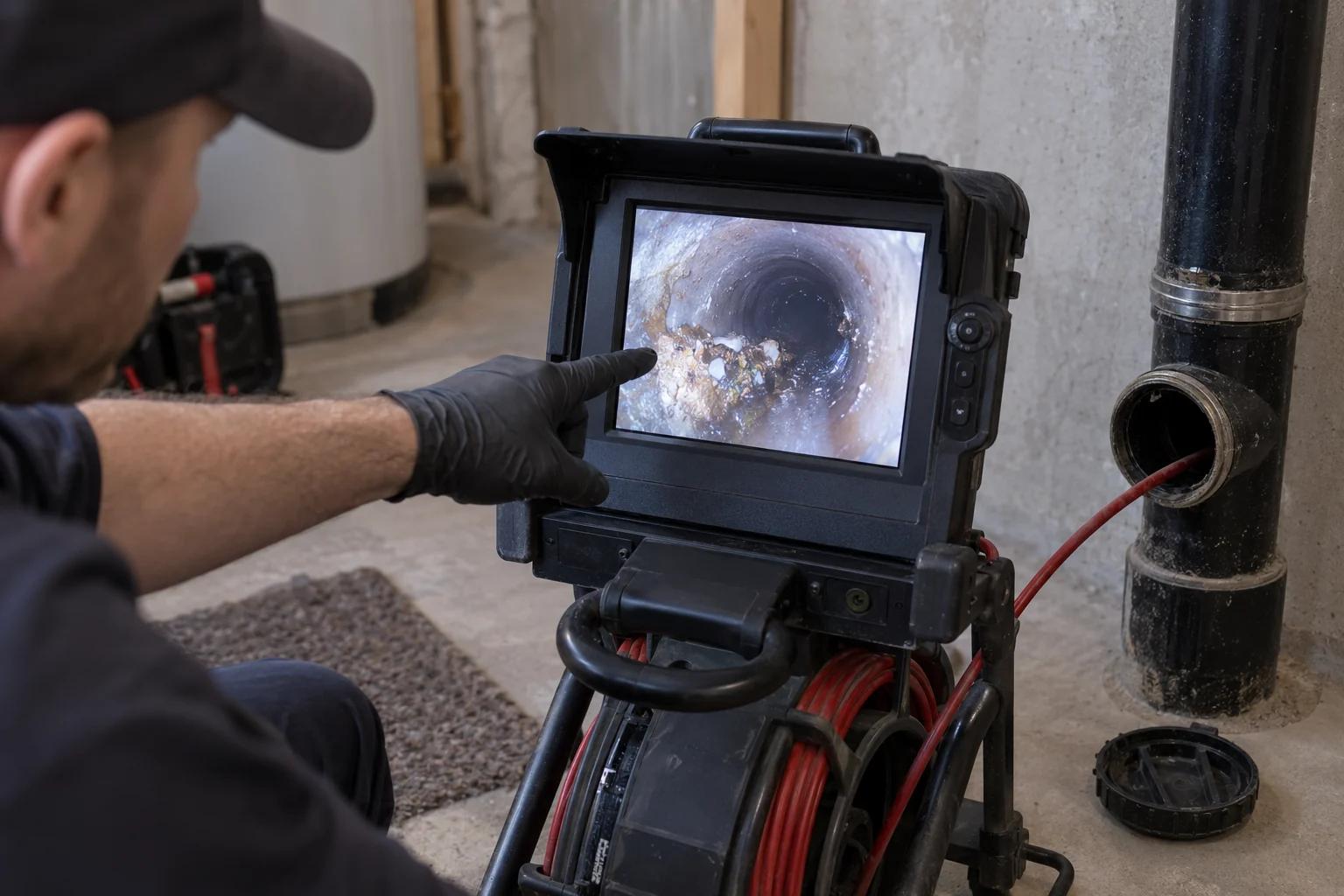
A sewer camera cannot identify every blockage cause on its own. It records what is visible along the accessible route, but wastewater, deposits, bends and a blockage can hide parts of the pipe. Some findings need cleaning, another access point or other tests before they support a diagnosis. An incomplete view should be reported as a limit rather than a clean bill of health.
A clear lens and an open route affect the answer
A camera is an observation tool, not a way to see through solid material. Thick deposits can conceal the pipe wall; standing water can obscure the lower surface; roots or an object can prevent further travel. Even when the screen shows a restriction, it may not show the condition behind that restriction or why material collected there.
That does not make the inspection useless. It may establish where progress stopped or which part of the route needs preparation. Ask what the technician can state confidently from the current view and what would need to happen before the remaining pipe can be examined. The distinction matters when a costly repair is being considered.
A single image can support more than one explanation
Water remaining in a pipe may suggest that drainage needs further assessment, but the image alone does not measure the entire line's slope or prove one particular defect. A stopped camera may have encountered a bend, a dense blockage or damage. The report should describe the observation before giving an interpretation and should not erase reasonable alternatives without evidence.
Likewise, a visible crack or offset needs a location and context. Is it the likely cause of the reported backup, or a separate condition worth noting? A useful sewer camera investigation connects what is seen to the household symptoms while acknowledging parts of the route that have not been evaluated.
Preparation can improve the inspection rather than invalidate it
When a line is backed up, controlled clearing may be necessary to drain wastewater and improve the view. The appropriate method depends on the pipe and its condition. For a visibly damaged line, aggressive cleaning may be unsuitable. Discuss the reason for preparation and the plan for checking the pipe afterward, instead of assuming that every line should be treated identically.
If several fixtures are affected, supply a list and describe which activities trigger the problem. This helps establish whether the inspection is following the relevant branch or common drain. A beautifully recorded kitchen branch cannot rule out a fault farther downstream that causes a basement backup during laundry.
Municipal and building questions need coordination
An inspection of private plumbing does not automatically establish the condition of municipal infrastructure. The City's sewage backup guidance explains how 311 can help determine whether a possible City issue needs consideration. Report simultaneous symptoms at other properties or units rather than treating each as an unrelated household blockage.
In a condominium or multi-unit building, involve management when access or shared pipes are involved. A camera view from one suite may cover only part of a common route. Ask who owns the report, which section it covers and whether another investigation is needed before assigning responsibility for repairs.
Common Visibility Limits and Their Implications
| Inspection limit | What the current view may show | What remains unanswered |
|---|---|---|
| Standing wastewater | That water occupies part of the accessible route | The condition of surfaces hidden below that water |
| Heavy deposits | The visible material and where progress becomes limited | The underlying pipe wall and any concealed defect |
| A restriction that stops the camera | The endpoint and whatever can be directly seen there | The condition and connections beyond that point |
| Unavailable access | Only the route reachable from the chosen opening | Other branches or sections that were not inspected |
Use this distinction when reading a recommendation. An incomplete image can justify more investigation, but it should not be described as proof that every hidden section is healthy or damaged. Ask what additional step would change the confidence of the diagnosis and whether that step is suitable for the present pipe condition.
A limitation can also remain after preparation. If cleaning or another access point still cannot provide a useful view, the report should preserve that fact. Repeating a camera pass does not automatically create evidence where the physical route remains inaccessible.
Questions That Prevent Overstating the Result
- Was the suspected problem actually viewed? If not, ask how the recommendation is supported and what alternative explanations remain.
- Does the report cover the branch causing my symptom? A visible route from one access point may not include every shared connection.
- Was the finding located? A distance reference is helpful, but ask what further location work is needed before structural work.
- What preparation was performed? Knowing whether footage was obtained before or after cleaning changes how deposits and pipe condition are interpreted.
- What is the next unanswered question? This makes a follow-up visit purposeful rather than another identical attempt without a defined goal.
If several people are involved, share the full report rather than only its conclusion. A manager or repair contractor should see the same limits as the homeowner. That reduces the risk of a tentative observation becoming a definitive claim through repeated retelling.
Keep a clear separation between drainage diagnosis and other incident decisions. A camera does not assess contaminated flooring, safe room occupancy or affected electrical equipment. Its usefulness lies in the pipe route that was actually inspected, and its report should state that scope without implying broader clearance.
What to ask when the camera cannot finish
Request the start point, distance reached, reason the view ended and any directly observed defects. Ask what additional action would answer the unresolved question: cleaning, a different access point, location work or another form of assessment. Avoid approving a full replacement simply because a tool stopped without establishing why it stopped.
For active wastewater return, limit fixture use and arrange backup assessment. Keep away from contamination and do not open a loaded cleanout yourself. If structural damage is supported by the evidence, discuss repair options against the actual finding. Calgary Emergency Plumbing can explain the next diagnostic step: call (587) 333-7742 or request service.