Can My Water Meter Help Identify A Hidden Leak In Calgary?
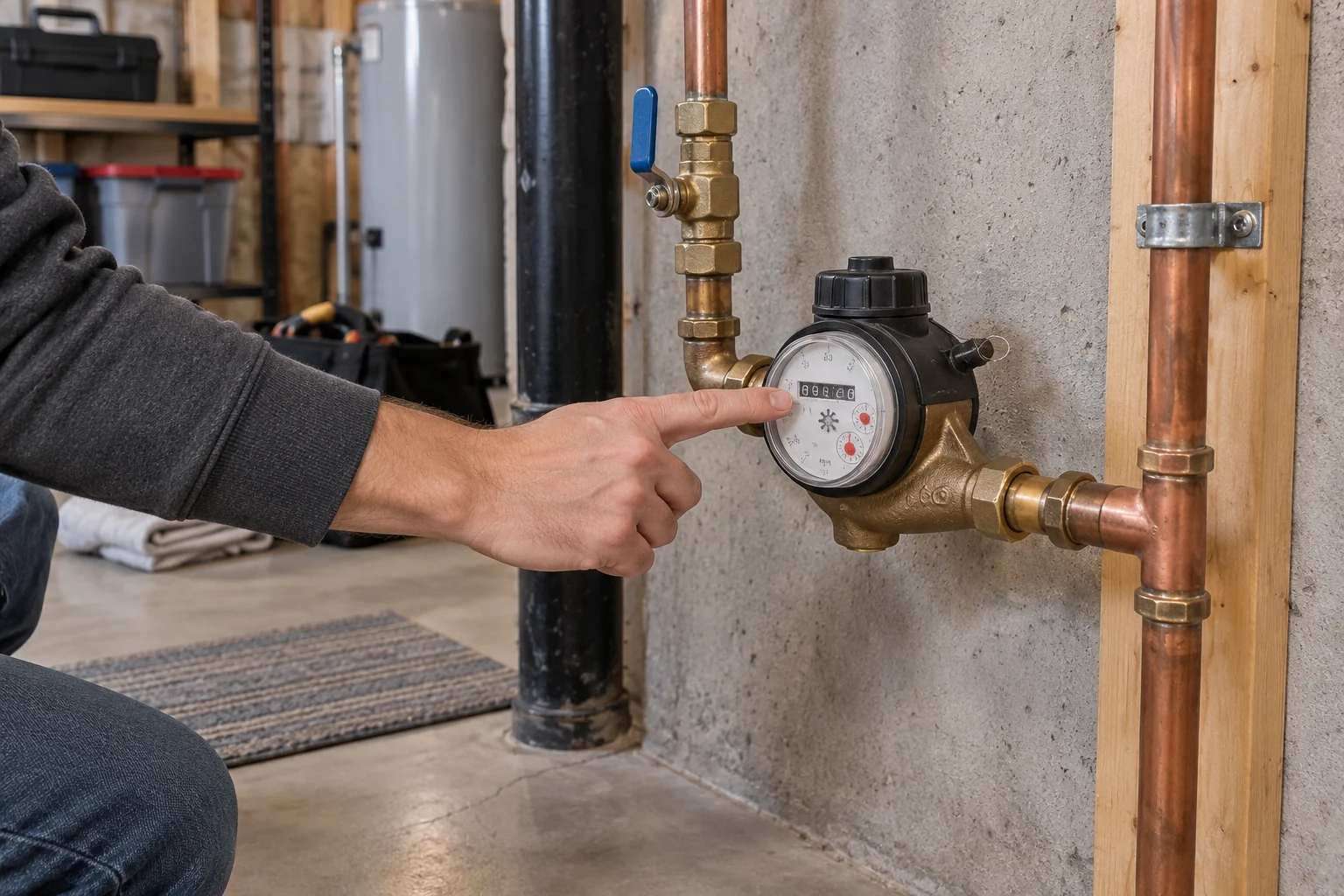
Your Calgary water meter can help identify unexpected water use when fixtures and automatic water-using equipment are accounted for. A change during an intended no-use period suggests further investigation, but does not locate the leak. Check the meter only where it is safely accessible, and do not treat the result as a test for every drainage or intermittent problem. A meter clue is one part of the broader hidden leak signs behind a wall investigation.
Find the correct meter without disturbing it
Calgary's water meter information explains the local metering context. Many household meters are indoors near the incoming supply, unlike advice written for communities with curb-side meter boxes. Identify your actual meter and display without removing covers or interfering with seals. In a shared property, confirm whether a reading relates to the suite or a broader building supply before trying to interpret household consumption from it.
Account for ordinary water use first
A washing machine, toilet refill, treatment system or another occupant can use water while you think the home is idle. Establish what is operating and whether any equipment has an automatic cycle. Do not disable unfamiliar equipment just to create a perfect test. A meter change means water passed through the measured supply, not automatically that a pipe is leaking. The usefulness of a quiet-period observation depends on understanding those legitimate uses and recording the circumstances honestly.
Record readings and timing clearly
Carefully note the accessible display reading, time and any known use. Compare like information rather than relying on a glance at a moving indicator without knowing what else is occurring. The City's household leak guidance can support the checking process. If access is unsafe or the display is unclear, ask for assistance. Do not enter a flooded utility area or manipulate a meter to obtain information that can be addressed another way.
Check visible fixtures before assuming a concealed pipe
A running toilet or dripping tap may account for unexpected use even if no puddle appears. Observe accessible fixtures without dismantling them. Some leaks discharge directly to a drain, so the home can look dry while water is still being used. Toilet repair assessment can address a suspected continuously running fixture. Explain the symptom and reading context instead of presenting the meter as proof that a particular toilet valve has failed.
Understand what a stable reading cannot rule out
A drainage leak may occur only when wastewater passes through a joint, and an intermittent supply leak may not occur during your observation. Water entering through the building exterior is another separate issue. A quiet reading therefore does not prove that every damp patch is harmless. If wetness recurs during a shower or laundry cycle, retain that pattern and have it assessed. A meter observation is one piece of information, not a universal moisture test.
Use findings to guide a professional assessment
For Calgary leak detection, provide the readings, timing, normal-use conditions and any visible symptoms. The plumber can assess whether the unexplained flow and wetness appear related. Do not repeatedly isolate unfamiliar valves or open a wall in response to one observation. A measured-use clue can justify investigation without establishing the source location, repair method or condition of concealed materials throughout the property.
Keep consumption and emergency response distinct
An active release into a room, water near electrical equipment or sewage backup needs attention even if a meter reading has not been obtained. Do not postpone a safety or source-control call to complete a consumption experiment. Our article on a sudden high Calgary water bill concerns a separate review of usage. Retain the meter record alongside the repair findings so later bill questions can be discussed with actual dates and observations.
Interpret a meter observation with its limits
| Observation | What it supports | What it does not prove |
|---|---|---|
| Reading changes during intended household idle time. | Review of normal use, automatic cycles and possible unexplained supply consumption. | The location of a wall, slab or service-line defect. |
| Reading appears stable during one observation. | A record of that particular quiet period under the known conditions. | Absence of every intermittent supply, drainage or exterior moisture problem. |
| Use changes after an identified fixture is addressed. | A useful comparison to discuss alongside the confirmed fixture findings. | A precise account of all prior consumption or entitlement to a billing adjustment. |
Keep a short consumption-observation log
- Date and time: record when each accessible reading was taken so two observations can be compared meaningfully.
- Known use: note running appliances, other occupants and automatic water-using equipment rather than describing the house as idle without checking context.
- Visible symptoms: record wetness or fixture sounds separately, avoiding an assumed link to the measured use.
- Controls changed: identify only known safe isolation already performed, including whether it altered the symptoms.
- Assessment result: add any confirmed source and repair date while retaining the original observations.
The log should remain simple enough to maintain accurately. There is no benefit in collecting many readings if their conditions are unknown or if doing so delays response to active water damage. A concise record can help the City account conversation or a plumber assess what needs investigation.
Do not use consumption checks as permission to manipulate a sealed meter, change treatment settings or operate common building controls. The occupant's role is to observe safely and communicate. Any uncertainty about the metering arrangement should be clarified through the appropriate provider or property contact.
After a repair, follow the agreed use restrictions and retain the findings. A changed reading may be consistent with correcting a source, but the repair record establishes what work occurred. Keeping those records together allows later questions to be answered without overstating what the meter alone demonstrated.
If a damp patch continues despite a quiet reading, report it as a separate unresolved symptom. Drainage use, intermittent timing and non-plumbing entry can require further assessment. The meter is a useful consumption clue, not a universal certification that concealed building materials are dry.
When another person checks the property, share the meaning and limits of the log. They should report ordinary conditions, not disable equipment, open meters or repeat uncertain valve operations in an effort to produce a more conclusive reading.