Do Urgent Water Leaks Still Need Utility Locates In Calgary?
If excavation is planned, yes. An urgent water-line leak does not by itself remove the need to identify buried utilities and follow the applicable ground-disturbance process. Utility Safety Partners provides emergency and priority request routes for qualifying conditions. Use those routes with accurate information and coordinate the actual work; do not treat an urgent request as automatic clearance to dig.
Distinguish A Faster Request From Permission To Dig
The useful distinction is between requesting urgent coordination and establishing the information needed for the planned disturbance. A call labelled emergency does not describe which services were located, what requirements apply or whether private infrastructure remains unaddressed. Ask the responsible contractor what has been reviewed before excavation. The building’s need for prompt repair should be communicated honestly without being treated as technical clearance.
Describe The Threat Accurately
Report the visible condition and what is currently affected. If water is interrupting a service, say which one is known to be unavailable. If the duration is uncertain, say when the issue was discovered rather than invent when it began. An accurate account helps the appropriate request process. It also leaves a useful record if the work scope changes after the site is inspected.
Contact The Relevant Locate Process
Utility Safety Partners’ current FAQ explains the emergency and priority routes for qualifying conditions. Use the current instructions and the relevant utility requirements, rather than rely on a remembered turnaround time or guarantee. The responsible contractor should confirm how the request is being handled for this work. A general guide cannot promise when responses will be complete at a particular Calgary site.
- Explain the leak and proposed excavation area when requesting the applicable locate route.
- Record utility responses and any remaining unknowns.
- Keep workers out of unassessed ground even when water is escaping.
- Coordinate the exposure method and water-line repair after the required checks.
Define The Actual Dig Area
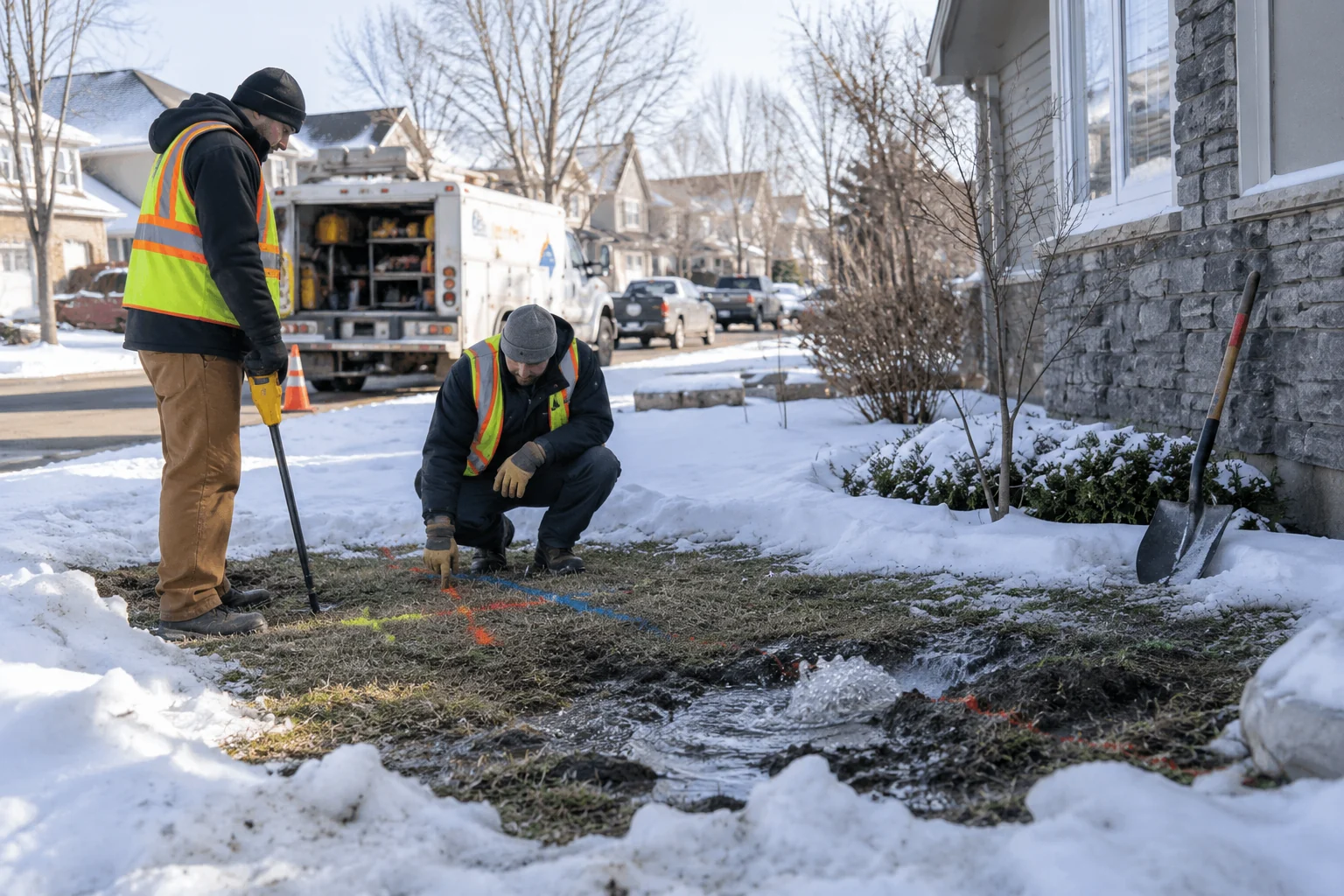
If the crew needs to expose beyond the initial wet area, communicate the intended change before disturbance expands. A water release can surface away from the component requiring repair. The work-area information must describe where the actual excavation is proposed, not just where staff first saw a puddle. Keep the responsible contact available to coordinate changes rather than authorize an undefined expansion.
Account For Private Site Infrastructure
Provide records of private power, communications, irrigation or other infrastructure where known, without assuming the list is exhaustive. Explain missing or outdated information to the contractor. The ordinary request process and additional site checks can address different parts of the infrastructure picture. Do not treat one completed step as proof that every privately installed service has been identified.
An urgent hydrovac service plan still depends on the applicable locate process. The underground water-line repair scope follows the safely exposed pipe finding.
Manage The Leak Without Improvised Excavation
While coordination proceeds, keep occupants away from affected ground and use only the appropriate established source-control process. Staff should not dig a small hole to make the urgent job easier. A temporary water restriction or barrier is not a repair, but it can be part of managing the current condition without creating an unreviewed excavation near buried services.
Keep The Returned Information Available On Site
Ask who holds the reviewed information and makes it available to the crew. The on-site work should not depend on an untraceable message that someone called about locates. If an old ticket is offered, let the responsible contractor determine its relevance to the present area and work. Keep changes in method or area visible so current requirements can be addressed.
Urgency may affect how a locate request is handled, but it does not prove every response is complete. Utility Safety Partners’ ground-disturbance guidance provides current ground-disturbance guidance; the crew must check the status for this excavation.
Check the emergency and priority locate guidance for qualifying conditions before planning excavation.
An Urgent Excavation Coordination Record
Use a short record that separates the water incident from the proposed dig. The incident description should state what is leaking, what service is affected and what source-control measures are already in place. The work description should identify the area the contractor proposes to disturb. Those descriptions can differ: water at a driveway edge does not establish that the pipe fault is directly beneath that wet spot.
- Request: Who submitted it, through which current route, and the reference supplied.
- Area: A description or plan of the intended disturbance and any later change.
- Responses: Which information has arrived, which remains pending and who reviews it.
- Private services: Available property records and the contact responsible for missing details.
- Restrictions: The current barrier, water interruption or access change and who maintains it.
This record is a coordination aid rather than clearance to excavate. Do not convert a pending item to “done” merely because the water leak is getting worse. Give the contractor the worsening condition so it can be managed alongside the outstanding utility work. If an emergency route is not applicable, the responsible parties still need to choose the appropriate request process under the current instructions.
When The Repair Area Changes
A crew may discover that the connection is farther away than expected or that another section must be reached. Stop treating the original area description as sufficient for every additional location. Ask the responsible contractor to review the revised disturbance against the returned information and relevant requirements. Keep a site contact available who can obtain property records and coordinate the change without asking maintenance staff to probe the ground.
If the leak can be controlled without excavation, the immediate response and any later underground work can have different timing. Record the temporary control and its limits, then plan the follow-up dig through the appropriate process. The title question concerns planned ground disturbance: a leak inside an accessible room does not itself mean a crew will excavate. Being precise about the proposed work avoids both an unnecessary dig and an unsupported assumption that urgency waives the checks.
Record The Repair And Remaining Site Work
At handover, distinguish the completed exposure, pipe repair and remaining site work. If the line is repaired while a surface or access restriction remains, communicate both facts. Keep the urgent coordination record with the findings so a later staff member understands what was done. Do not remove barriers simply because the leak stopped or the first contractor departed.
When arranging help, give the crew the leak location, proposed dig area and status of locate responses. Ask which finding, test and remaining restriction will be recorded. Request service or call (587) 333-7742.