
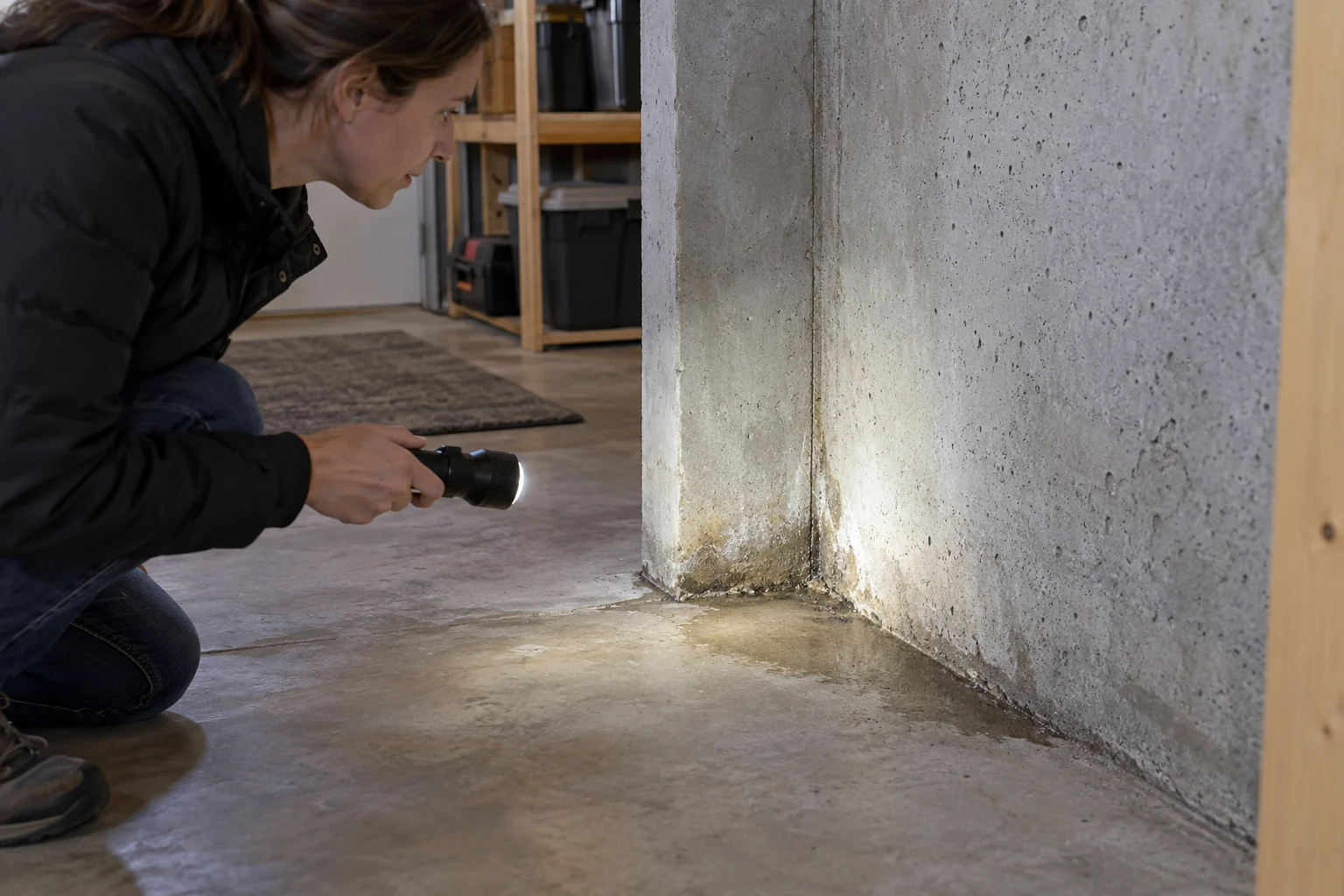
Is It A Slab Leak Or Foundation Seepage In Calgary?
A slab leak involves a plumbing source beneath or associated with the slab; foundation seepage involves water entering through the building envelope or surrounding ground conditions. In Calgary, both can appear as basement wetness, and surface symptoms can overlap. Record the timing, location and relationship to plumbing use or weather, then arrange assessment rather than assuming the repair trade from the puddle alone.
Record what happens before the water appears
Note whether wetness follows a shower, laundry drainage, prolonged idle time, rainfall or thaw conditions. Timing can guide the investigation, but weather and plumbing activity can coincide. Do not call the source confirmed merely because one event happened first. Preserve what you observed and what remains unknown. A dated room photograph from a dry position can help explain the pattern without opening finishes or tracing a pipe through concealed areas yourself.
Observe the entry location without overclaiming
Water along a wall-floor junction raises a different assessment question from wastewater rising through a drain, but neither observation alone reveals the entire route. Water can travel across or beneath materials before becoming visible. Describe the visible point and nearby fixtures instead of drawing a presumed route. If the room includes a wet panel, sewage or unstable finishes, those safety conditions should be reported first. An inaccessible area is a legitimate assessment limit, not a reason to enter it for a closer look.
Use supply-consumption evidence appropriately
Unexpected meter use can support checking a plumbing supply, provided normal use and automatic equipment are understood. It does not establish an under-slab location. A stable meter observation also cannot rule out drainage leakage or exterior moisture. For Calgary leak detection, explain the reading context alongside visible symptoms. Keep water-use data and weather observations separate until the assessment establishes whether they appear related rather than forcing them into a single explanation.
Distinguish groundwater management from sewer flow
A sump system and a sanitary drainage system serve different purposes. Water rising through a floor drain needs a drainage assessment, while a sump problem may involve groundwater management. Calgary's water management guidance gives local context for these systems. A homeowner should not pour more water into a blocked drain or adjust unfamiliar pump wiring to test a theory. Describe the actual symptom and which equipment is already present.
Ask which professional should assess the next stage
If the plumbing assessment supports a concealed pipe source, slab leak repair can address that work. If the evidence points to building-envelope entry, another appropriate professional may be needed. A plumber identifying no confirmed supply fault does not automatically certify the foundation, and an exterior assessment does not establish every internal pipe is sound. Ask what was examined and what remains outside scope so the handoff is based on findings rather than exclusion by assumption.
Keep source work and damaged materials separate
Both types of water can affect flooring, walls or concealed assemblies. Source control does not automatically dry those materials, and visible evaporation does not prove recovery is complete. Ask what material assessment is appropriate and retain the record. Our article on leak repair versus restoration in Calgary explains the distinction. The recovery stage should reflect actual affected conditions rather than being attached to a diagnosis that has not yet been confirmed.
Choose the repair after identifying the source
Do not authorize concrete access, exterior digging or drainage work because an internet checklist seems to match the stain. Ask for the evidence linking the proposed work to the source. Multiple contributors are possible, so a limited finding should remain limited. Useful documentation records the weather, fixture activity, readings and assessed locations. This approach makes later recurrence easier to evaluate and prevents every wet basement incident from being treated as either a slab leak or foundation seepage without support.
A source-pattern comparison for basement wetness
| Pattern reported | Relevant distinction |
|---|---|
| Wetness appears during fixture drainage. | A drainage or fixture source may need assessment; the floor location does not alone make it a slab supply leak. |
| Unexpected supply use appears while wetness recurs. | The consumption clue and moisture clue need to be linked by assessment, with normal use accounted for. |
| Water enters near an exterior boundary after weather. | Building-envelope or groundwater conditions may be relevant, while coincident plumbing activity remains a separate observation. |
| Wastewater rises through a floor drain. | Drainage backup and contamination need attention rather than a presumed foundation or supply repair. |
Keep a combined weather and plumbing record
- Observation time: note when water was seen, not an assumed start time for hidden entry.
- Visible point: identify the wall, drain or floor location without presenting it as the complete route.
- Recent weather: record rainfall or thaw context honestly; absence of rain at discovery does not rule out earlier ground moisture.
- Fixture activity: include relevant use already observed without deliberately repeating it.
- Equipment: identify a sump or other known system and any existing symptom, without adjusting its wiring or controls.
- Assessment result: add confirmed source findings and limits while retaining the original records.
A useful handoff can show that two possibilities were considered and only one was supported by the available findings. It can also show that the source remains uncertain. Both are preferable to switching labels between foundation seepage and slab leak based on the latest stain description.
When a professional recommends another trade, ask what that next assessment should address and what the first visit did not establish. A plumbing assessment can identify no confirmed supply source without certifying the entire envelope, just as an exterior review does not test every internal drain.
Keep immediate restrictions visible while the source question is resolved. An unsafe room, sewage or wet electrical equipment requires appropriate advice regardless of which diagnostic label is eventually used. The record should support coordinated work without asking the occupant to settle the source by drilling, pouring water into drains or operating unfamiliar equipment.
Keep rainfall dates, meter observations and photographs of the first wet areas in separate notes. A plumber may rule in or out a supply leak, while a building-envelope or drainage specialist may need to assess ground entry. If both causes remain possible, tell each provider what the other actually found. That gives the next visit a useful starting point without treating a guess as a diagnosis.