Is A Double Sink Trap Or Shared Drain Blocked In Calgary?
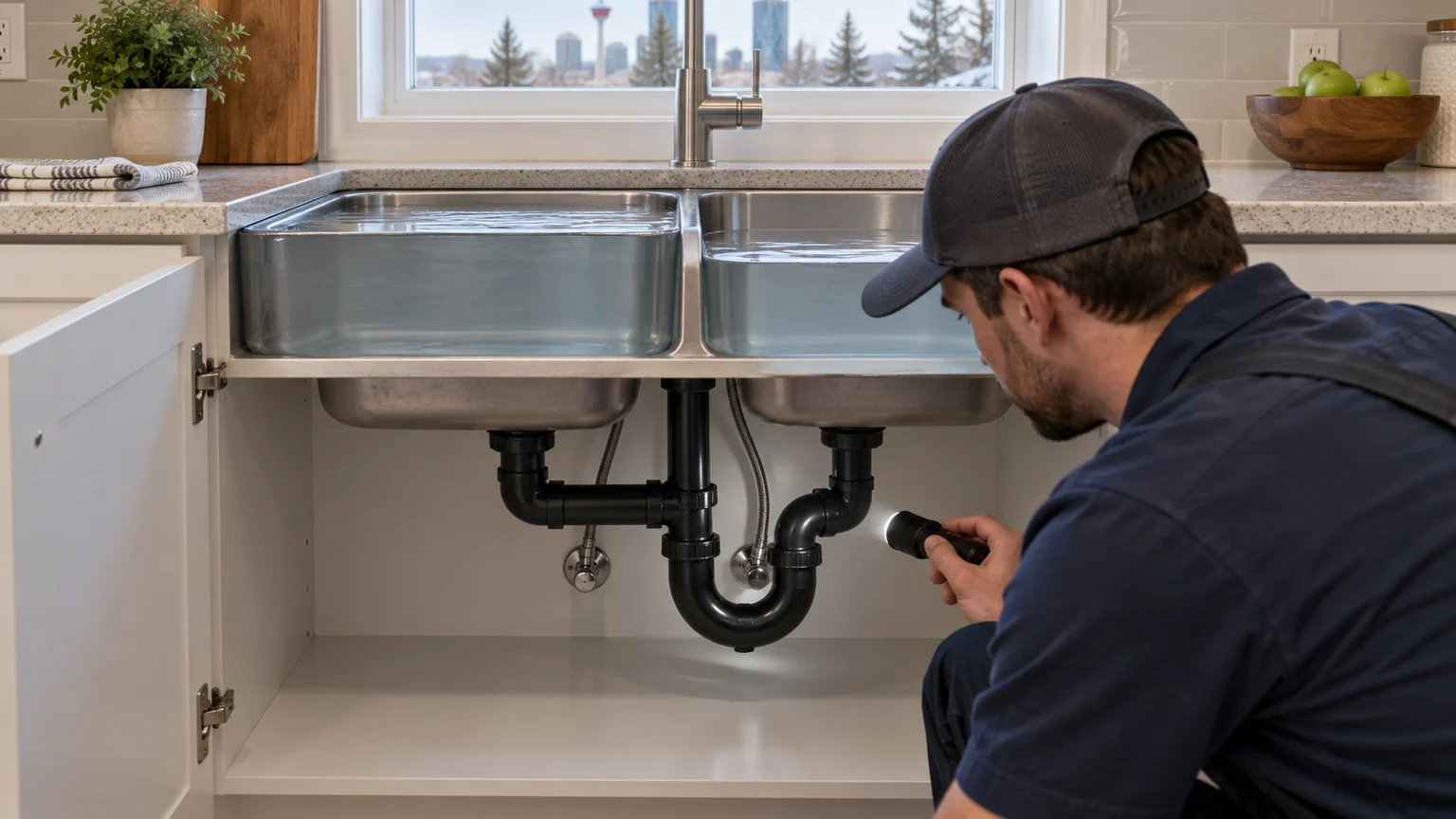
An overflowing double sink may have a restriction in its shared trap or a farther downstream branch; the bowl pattern alone cannot reliably tell you which. Water transferring between bowls shows they are connected, not the exact blockage location. Stop using both bowls and connected appliances, report when the water rises, and arrange assessment of the common route rather than dismantling it during an active overflow.
Both bowls can reveal one common restriction
Many double sinks join before wastewater reaches the branch serving the kitchen. If that common route is restricted, discharge from one bowl can appear in the other. This can make a single blockage look like two separate fixture faults. Tell the plumber whether both bowls are slow and which activities cause transfer between them.
A symptom confined to one bowl can have a nearer cause, but that observation is still only a starting point. The connection arrangement and actual condition need examination. Avoid deciding that the trap is clear simply because one bowl initially accepts a small amount of water.
Dishwasher discharge can expose a downstream limitation
A dishwasher often shares the general kitchen drainage route. If its drain cycle raises both bowls while a small tap stream seems to drain, mention that contrast. It may help the technician assess the receiving pathway and choose an appropriate controlled test after the immediate spill is stopped.
Pause the appliance rather than repeatedly running it to prove the symptom. Water already held in the line can spill when a trap is opened, so do not loosen fittings during the backup. Tell the technician about a disposer, recent sink changes or any modifications to the appliance hose connection.
Trap cleaning is not always the complete remedy
A trap can contain local material, but buildup may also extend along the branch. Clearing only the accessible trap can leave a downstream restriction that produces the same overflow soon afterward. Ask which part of the route was examined and whether the findings account for all the observed symptoms.
Double sink overflow assessment can identify the relevant connections and common drain. If deposits remain in a suitable route, discuss drain cleaning options. If the problem is recurrent or the pipe condition is uncertain, further inspection may be needed rather than another assumption that the nearest fitting is responsible.
Do not confuse a drain leak with a backed-up bowl
Water returning into the bowl and water escaping under the cabinet are different observations, though they can occur together. A restricted route can expose weaknesses at a drain connection. Tell the plumber where each spill appears and whether the cabinet leak happens only when one or both bowls are emptied.
Drain connection repair may be needed alongside clearing the obstruction. The repair should address the leaking component and the pressure or loading caused by the restriction where relevant. Tightening a joint does not explain why the bowls overflow, just as clearing the line does not establish every connection is sound.
Questions Before Opening a Double-Sink Trap
The visible trap is accessible in many kitchens, but that does not make opening it the right first action during a loaded backup. The route may contain wastewater or chemicals, and the restriction may be farther away. Ask the technician how the assessment will distinguish the trap from the shared branch.
- Connection arrangement: How do the two bowls and any appliance hose join the route?
- Observed transfer: Does water move between bowls only during draining or also during appliance use?
- Material and condition: What evidence identifies deposits, an object or a component fault?
- Downstream scope: If the trap is cleared, how will the receiving branch be assessed?
- Leak assessment: Are any under-cabinet drips part of the same visit, and which joints are actually wet?
A local clearing can be useful, but its scope should remain clear. If the downstream route remains unknown, a better-looking bowl is not proof that the full kitchen branch has been assessed. Retain any recommendation for further investigation.
A Double-Sink Verification Checklist
| Reported condition | Verification question |
|---|---|
| One bowl fills while the other empties | Does the selected controlled check address transfer through the common connection? |
| Dishwasher discharge fills both bowls | Was the appliance connection and receiving route included? |
| The cabinet leaks while draining | Were the specific wet fittings repaired and checked separately? |
| The problem returns after local clearing | What remains uncertain farther along the shared route? |
The check should be selected by the technician after source assessment. Do not perform repeated full-basin releases into a line that is already spilling. A report that states the tested conditions is more useful than a general assurance that the sink now works.
Keep earlier service notes so the next investigation can identify what changed. A new sink installation or disposer connection may alter the branch arrangement, while older deposits or pipe defects can remain outside that change. The repair explanation should be grounded in the current observations instead of assigning every symptom to the newest component.
Communicate restrictions on connected appliances as well as the two bowls. A kitchen user may avoid the sink yet unknowingly send dishwasher water into the same unresolved route. Clear instructions reduce that risk while the underlying restriction or connection fault is being addressed.
Where earlier kitchen work changed the trap or appliance connection, retain photographs or notes of that arrangement. They can help the assessment compare changed components with the current route. Do not treat an old photograph as proof that the hidden branch remains unchanged or that a new fitting is necessarily responsible.
Check the whole kitchen scenario after the work
Ask how both bowls and the connected dishwasher route will be evaluated. A controlled test selected by the technician can check the conditions that originally caused water to rise. Do not perform your own repeated stress tests when the line is actively spilling or its condition remains unresolved.
The City of Calgary sewage backup guidance gives useful prevention advice about keeping grease and unsuitable household materials out of drains. Keep the inspection and repair findings so a later recurrence can be compared accurately. For a Calgary double sink with an active overflow, limit water use and call (587) 333-7742 or request service.