
What Does Professional Leak Detection Involve In Calgary?
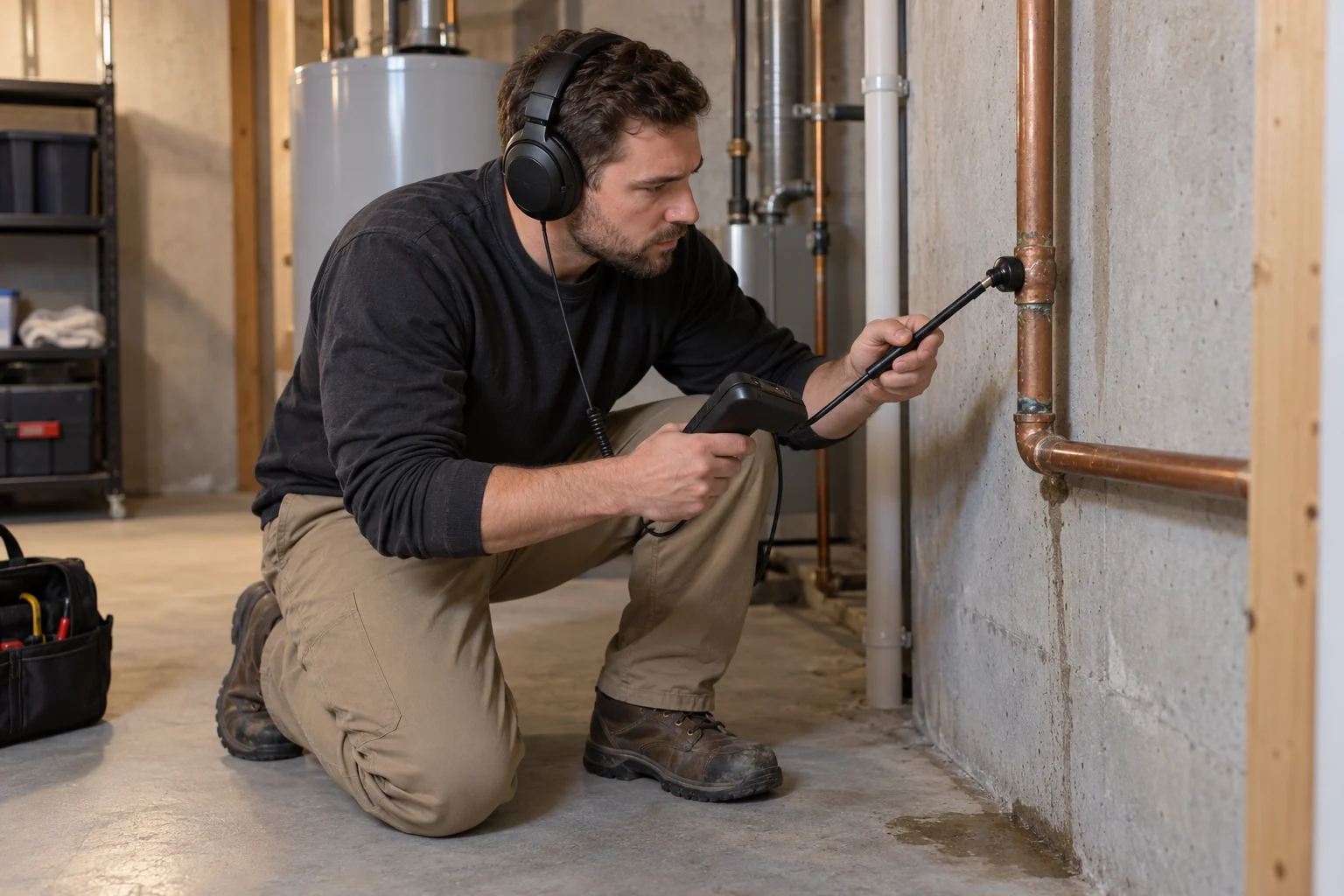
Professional leak detection in Calgary combines the leak timing, plumbing route and accessible checks to narrow the source. Depending on the problem, thermal imaging can highlight surface temperature patterns and moisture readings can help assess affected material. These clues do not identify a failed fitting by themselves; the investigation must connect them to the relevant plumbing. If staining is the first clue, see the warning signs of a leak behind a wall.
Begin with the reported pattern
The assessment starts with where water appears, when it appears and what was operating. A recurring ceiling stain during shower use raises a different question from unexplained consumption while every fixture is idle. Give the chronology rather than only the largest photograph. Recent repair work, cold exposure or a change in occupancy may be useful context, but none establishes the cause on its own. The aim is to narrow the investigation without treating the homeowner's first theory as a confirmed fact.
Consider the plumbing route and access
Visible piping, fixture connections and building layout can help establish which systems may be involved. Concealed runs may need additional assessment or justified access. In a shared building, another suite or mechanical room might be relevant to the route. Explain who can authorize entry. A professional should be able to describe why a particular area warrants investigation rather than assuming the leak sits directly behind the visible stain. Access constraints can limit what can be confirmed at an initial visit.
Distinguish consumption clues from moisture clues
A meter may show unexplained use without locating the escaping water. A damp material observation may show where moisture is present without identifying the source. Calgary's household leak guidance provides context for ordinary source checks. These clues are useful together, but neither should be exaggerated into a guarantee. Drainage leaks, intermittent faults and non-plumbing moisture can behave differently from a continuous supply release measured by the household meter.
What the tools actually show
A thermal camera records temperature patterns at a surface. It does not see through a wall or photograph the leaking fitting. As equipment manufacturer FLIR explains in its water-leak imaging guidance, moisture can create a temperature difference that helps direct an investigation. A moisture meter can then check material in an area of concern. The image and reading help assess affected material; the plumbing source still needs to be identified.
This distinction matters when a ceiling stain sits below several pipes. A temperature pattern can guide where to look, but it cannot by itself tell the homeowner which connection failed. Ask whether the finding concerns a wet material, a suspected source area or a component the professional has directly examined.
Match the check to when the leak appears
Plumbing checks should address the reported sequence. If moisture appears only during shower use, describe whether it starts while water is running or later. If the meter registers unexplained consumption when fixtures are idle, identify any automatic water-using equipment that could affect that observation. These are different leads, so a visit should not treat every stain as evidence of a continuously leaking supply.
Give the investigator permission and access information before testing or opening concealed areas. Do not recreate a leak yourself to demonstrate it: additional water may damage materials or reach electrical equipment. A professional can decide which checks are appropriate and explain what a result does or does not establish.
Understand when an opening may be justified
Access to concealed piping can become necessary to confirm or perform the repair. That does not mean the whole room must be opened immediately. Ask what supports the proposed location and what safety or material considerations apply. Avoid creating a hole yourself ahead of the visit. For slab leak assessment, the same principle applies to concrete access: the proposed work should follow the findings and available options rather than an automatic assumption about extensive demolition.
Separate locating the source from repairing it
A detection finding should lead to a defined next decision. Calgary leak detection and water leak repair address related stages, but identifying a likely area is not necessarily completion of the repair. Ask which component was confirmed, what work is proposed and which part of the assessment remains limited by access. A repaired source also does not certify that all affected finishes are dry or that unrelated electrical equipment is safe.
Retain findings that another professional can use
Request a practical record of the observations, identified source, assessed areas and recommended follow-up. Keep relevant photos and timing notes with it. If the leak is intermittent or not reproduced during the visit, that limitation should remain clear rather than being silently replaced with a confident diagnosis. Good documentation helps the next assessment proceed from evidence. It also makes future recurrence easier to describe without assuming that every wet patch in the same room has the same cause.
What a useful leak-assessment explanation includes
- Reported pattern: the timing and locations that guided the investigation, without presenting the homeowner's theory as established fact.
- Systems considered: relevant supply, drainage or other moisture possibilities and why one source requires further attention.
- Areas assessed: accessible fixtures, piping or rooms examined, together with concealed or restricted areas not evaluated.
- Method purpose: what the chosen check was intended to establish, rather than only the name of a tool.
- Finding strength: distinguish a narrowed area, likely source and confirmed failed component so the repair proposal matches the evidence.
- Next decision: explain justified access, further investigation or repair and how its scope will be authorized.
An example of a useful finding
A report might say that moisture was found beside a shower, accessible supply connections showed no visible leakage during the visit, and the concealed drain connection was not examined. That is useful information, but it is not a confirmed drain diagnosis. Ask which next check or access point would distinguish the remaining possibilities and what permission it needs.
Keep any change in the pattern with the report: a stain that now grows when the shower is unused may alter the next investigation. Describe the observation and time instead of replacing the original finding with your own diagnosis. The purpose of follow-up is to test a specific remaining question, not to repeat the same broad search without the earlier evidence.