What Should Staff Avoid During A Hydronic Leak In Calgary?
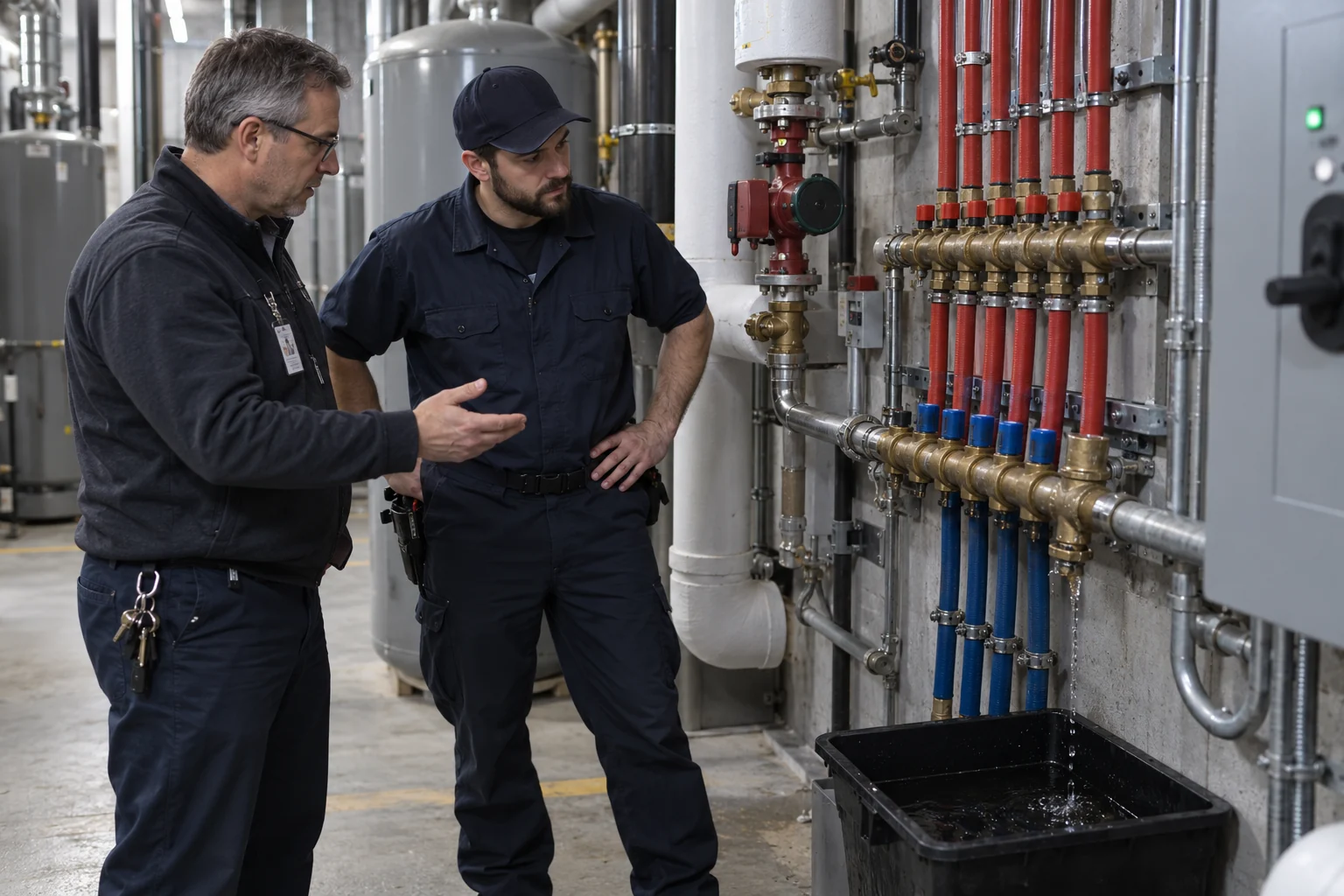
During a hydronic leak in Calgary, building staff should avoid adjusting unfamiliar pressure or filling controls, opening vents or relief devices, bypassing protection and repeatedly resetting equipment. Those actions may not stop the source and can change the conditions a technician needs to investigate. Keep people away from hot fluid and wet utilities, report the actual observations and follow the qualified instructions for the installed system rather than a generic internet sequence.
Do not confuse routine controls with service adjustments
Staff may be authorized to use ordinary equipment controls under the building's procedures. That does not mean they should change internal settings or operate unfamiliar service valves during a leak. A thermostat instruction, a boiler service adjustment and a common-system isolation are different actions. Ask the responsible technician which action applies and who is qualified to perform it.
For Calgary hydronic pipe leak repair, explain what staff have already done. Include the control, instruction used and observed effect. Do not omit an unsuccessful adjustment because the equipment now looks normal. The technician needs the actual history to understand the present condition and avoid repeating a change whose result is unknown.
Leave pressure and filling arrangements to qualified investigation
A changed gauge reading can tempt staff to add water until the number looks familiar. That does not identify a leak or other system issue. The installed loop, fluid and equipment requirements matter. Repeated makeup can obscure the pattern and may leave the underlying problem unresolved. Tell the contractor about any filling already done and stop treating it as an improvised repair.
Manufacturer Caleffi's hydronic circuit explanation shows the role of separate system components. Its diagrams provide background, not permission to adjust a building by analogy. A technician should use the actual installed equipment and instructions. Do not copy a pressure value from another property's diagram or turn a component until the display matches it.
Do not open, block or bypass protective devices
Relief, venting and water-protection components have specific roles. Staff should not block a discharge, remove a device or bypass it to stop apparent water loss. What looks like an inconvenient release may be relevant to a broader problem that needs inspection. Provide the visible location and behaviour without dismantling the component to make the room dry.
Calgary's business cross-connection guidance explains drinking-water protection where systems connect. An improvised hose or bypass to refill the loop is not an ordinary workaround. If the site lacks the information or access needed for service, tell the contractor and management. Uncertainty should prompt qualified help, not removal of a protection whose function staff do not know.
Do not reset equipment repeatedly to preserve heat
An alarm or shutdown can contain information about the equipment's condition. Repeated resets may erase the sequence staff need to report or return equipment to operation before the cause is resolved. Record the displayed message where it can be seen safely and tell the responsible technician. Follow the actual equipment instructions and the building's authorized procedure.
If heat becomes unavailable, management should coordinate occupants and any necessary arrangements through appropriate professionals. Staff should not use improvised indoor combustion heating or modify plumbing to keep the building running. The operational need is real, but it does not make an unfamiliar control change suitable. A source leak, equipment condition and occupied-space heating needs may each require a defined response.
Use a staff instruction that names what must remain untouched
- Do not adjust pressure or fill controls to chase an assumed target.
- Do not open service vents or relief devices as an experiment.
- Do not cap a discharge or bypass a water-protection component.
- Do not operate unfamiliar common or life-safety valves.
- Do not repeatedly reset alarms or restart restricted equipment.
- Do not handle wet electrical equipment or approach hot released fluid.
- Report the actual observations and previous actions to the technician.
- Use only the specific authorized instruction for the installed system.
Pass this instruction to incoming staff, cleaners and contractors entering the area. A single employee's understanding is not enough when others may see a closed valve or an alarm later. Identify who can change the restriction. Avoid an unlabeled temporary setup that another person might return to normal without knowing why it was left that way.
Collect information without manipulating the system
Record the room, first visible fluid, timing and any safely readable display. Provide current drawings, labels and equipment model information where available. Mention recent maintenance, filling or alterations. If a document is old or a route is uncertain, say so. Those facts help the technician plan investigation without staff creating another condition to see what happens. A heating loop losing pressure without a visible puddle needs a recorded pattern, not repeated staff adjustments.
Our Calgary commercial emergency plumbing service can discuss the private source work with the responsible manager. Explain access limits and who can authorize repair or wider interruption. Staff should not enter a restricted mechanical room or work beneath unstable finishes to complete the information list. A missing observation can be investigated safely by the appropriate person.
Ask for a clear return-to-operation instruction
After repair, the technician should explain what was found, what changed and whether any restriction remains. Record who restores controls and what checks apply to the actual system. Do not assume a dry floor means equipment can be restarted. If another qualified provider handles the heating equipment, coordinate their result with the source repair.
Where an alteration is proposed, clarify relevant approvals using Calgary's plumbing and hydronic permit guidance and the actual work. Cleanup of the released fluid and affected materials also needs a defined scope. A local pipe repair does not automatically address every wet component, finish or utility nearby.
Turn the incident into a better operating procedure
Keep the failed component, repair boundary and professional instructions in the building's maintenance record. Update unreliable labels or drawings through the responsible process where findings showed a problem. Identify routine staff checks separately from tasks that require a qualified technician. The next shift should know what they may observe and whom they call, not inherit a habit of adjusting gauges by guesswork.
If the symptom returns, report the new timeline and the earlier findings. Do not start another sequence of resets or filling before the source is understood. For Calgary building staff, the most useful action during a hydronic leak is controlled reporting and adherence to appropriate instructions. It preserves the information needed for diagnosis while keeping unfamiliar service adjustments from creating a second problem.