Why Does The Sink Fill As The Dishwasher Drains In Calgary?
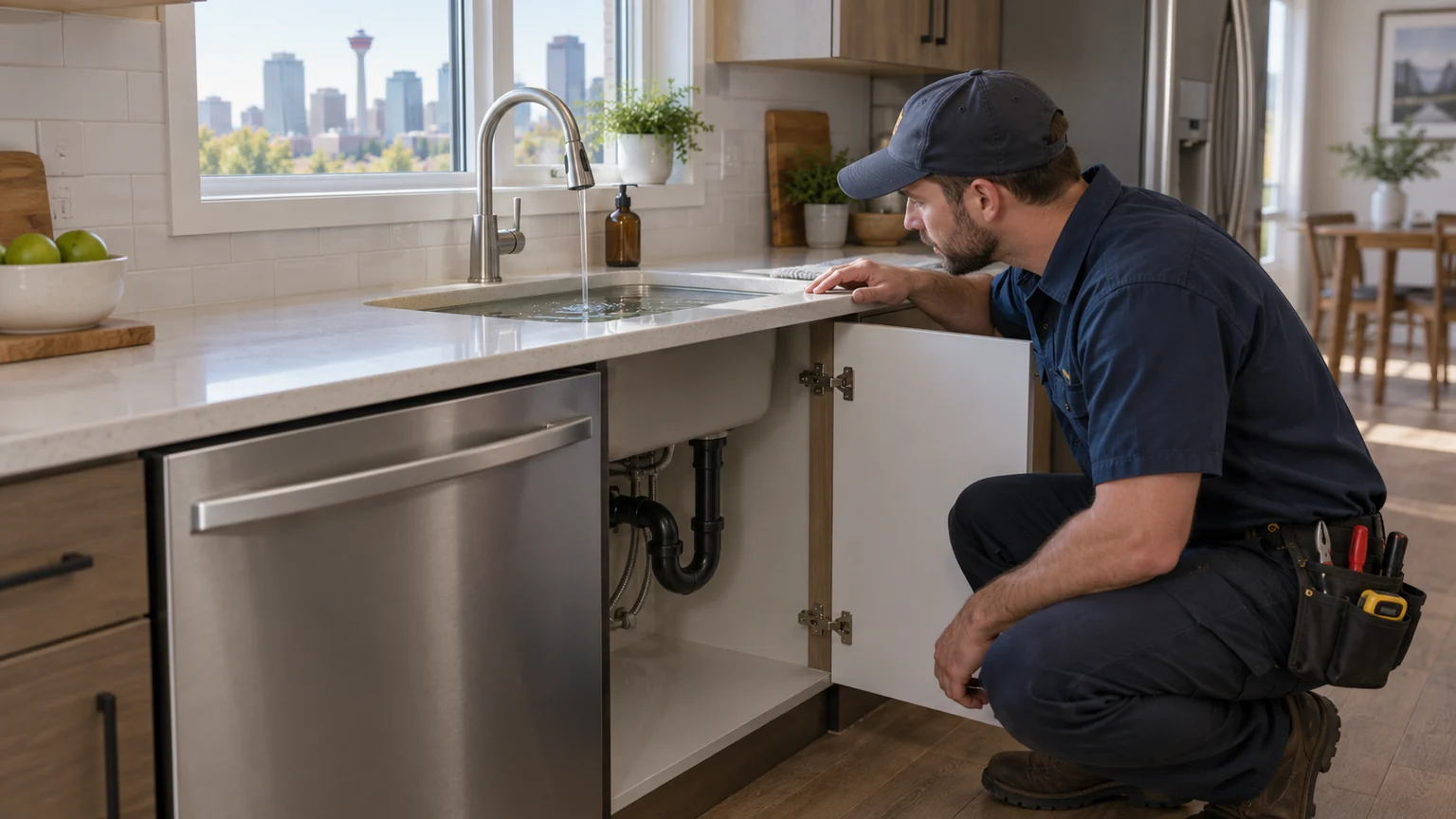
A sink can fill during dishwasher discharge when the drainage route receiving that water is restricted. The dishwasher may be pushing water into a branch that cannot carry it away, so it returns through the sink. This does not by itself prove an appliance fault. Pause dishwasher use and have the sink connections and downstream drain assessed before running another cycle.
The drain cycle is a useful timing clue
A dishwasher releases stored wastewater during particular stages of its cycle. If that discharge makes the sink rise, the connection and shared route deserve attention. Tell the plumber whether the sink behaves normally under modest tap flow and whether the problem begins only when the appliance pumps out.
Do not interpret normal tap drainage as proof that the line is unrestricted. Different flow patterns can reveal a limitation that a small stream does not. Avoid repeatedly running the dishwasher to recreate the overflow; the previous sequence and photographs taken safely can help guide the assessment without adding another spill.
Look at the connection and the route as separate questions
The dishwasher hose and its connection can have their own problems, while the sink trap or branch may be restricted independently. A technician needs to determine whether wastewater is being delivered appropriately and whether the receiving route can drain. The visible symptom at the sink is not enough to choose between those causes.
Explain whether there was recent installation work, a new sink, a changed disposer or a hose adjustment. Those changes can affect the starting point for assessment. Do not dismantle a hot or water-filled connection yourself, and do not move the appliance across a wet floor to reach it.
Repeated kitchen buildup needs a reason
Grease and food deposits can collect along a branch, but objects and pipe conditions can produce similar symptoms. Ask what was found rather than assuming every dishwasher-related sink overflow is grease. If a previous cable clearing helped only briefly, provide the service note and describe how the symptom returned.
Sink overflow assessment can address the affected drainage route, while dishwasher connection assessment is relevant if water also escapes from the hose or supply connection. Where deposits and pipe condition support it, drain cleaning options may be discussed. Equipment choice should follow the diagnosis.
Manage the returned water as a drainage spill
Dishwasher wastewater and water returning through a drain should not be treated as clean drinking water. Keep children and pets away and avoid tracking the spill through the home. Water collecting inside cabinets or beneath flooring may require assessment beyond stopping the appliance. Source repair does not establish that those materials are dry.
For prevention context, the City's sewage backup guidance explains keeping fats and unsuitable household waste out of drains. Scraping cookware and appropriate disposal help reduce new deposits, but those habits will not remove an existing blockage. Do not add chemical cleaner to a full sink, particularly when appliance hoses and concealed connections are involved.
A Dishwasher-to-Sink Sequence to Record
The drain-cycle trigger provides useful context, but the connection and receiving pipe still need assessment. Record the sequence from the last event rather than starting another wash. This helps distinguish a route restriction from an external appliance leak without opening the machine or disconnecting a wastewater hose.
- Cycle stage: Say whether water rose when the dishwasher pumped out or whether a puddle appeared earlier during filling.
- Sink behaviour: Identify the first bowl to rise and whether the second bowl followed.
- Ordinary tap use: Describe whether small tap flows had been draining normally before the appliance event.
- Recent changes: Include a new disposer, sink, drain fitting or altered hose connection.
- After stopping: Report whether the sink dropped slowly or remained full after the appliance was paused.
A bowl that gradually drains after the discharge stops can still reflect a restricted route. Do not treat that improvement as a reason to run another full cycle before the source is assessed. The technician can choose a controlled check once the route and immediate spill are addressed.
Compare Internal Return and External Leakage
| Water location | Relevant assessment |
|---|---|
| Rising inside the sink | The receiving drain route and the dishwasher's discharge connection |
| Dripping from a hose beneath the cabinet | The actual hose or fitting source and the surrounding connection arrangement |
| Pooling beneath the appliance | Whether the water belongs to a plumbing connection or an appliance component |
| Reaching flooring or another room | Separate source control and affected-material assessment |
These observations can coexist. If the drain is restricted and a hose leaks, the explanation should account for both rather than declare the dishwasher itself defective from one puddle. Ask which component was directly observed and whether another route remains unexamined.
After the work, keep the connection and drain findings together. A hose repair alone does not establish that the sink can receive the appliance's discharge, while a cleared branch does not prove every appliance connection is sound. A useful verification record identifies the repaired source and the controlled conditions checked.
For a shared kitchen, tell all users whether the appliance or sink remains restricted. The goal is to avoid an unplanned restart while the route is still uncertain, not to shift responsibility for a mechanical or drainage fault to whoever happened to start the last cycle.
If the appliance was newly installed, provide the installation date and any connection notes. The timing is useful context but does not prove an installation error. The current assessment still needs to establish whether the source is a hose, appliance component or receiving drain and explain how that finding was checked.
Test the pathway that originally failed
After repairs or clearing, ask how the shared kitchen route was checked and whether a controlled dishwasher discharge test is appropriate. The goal is to assess the actual pathway involved in the event rather than obtain one successful tap drain and assume every appliance connection is satisfactory.
Keep the finding and any remaining limitation in the home's records. If the problem comes back, distinguish sink water rising from an external appliance leak: those observations can indicate different next steps. Calgary Emergency Plumbing can help assess the plumbing connections and drain receiving the dishwasher's wastewater: call (587) 333-7742 or request service.