
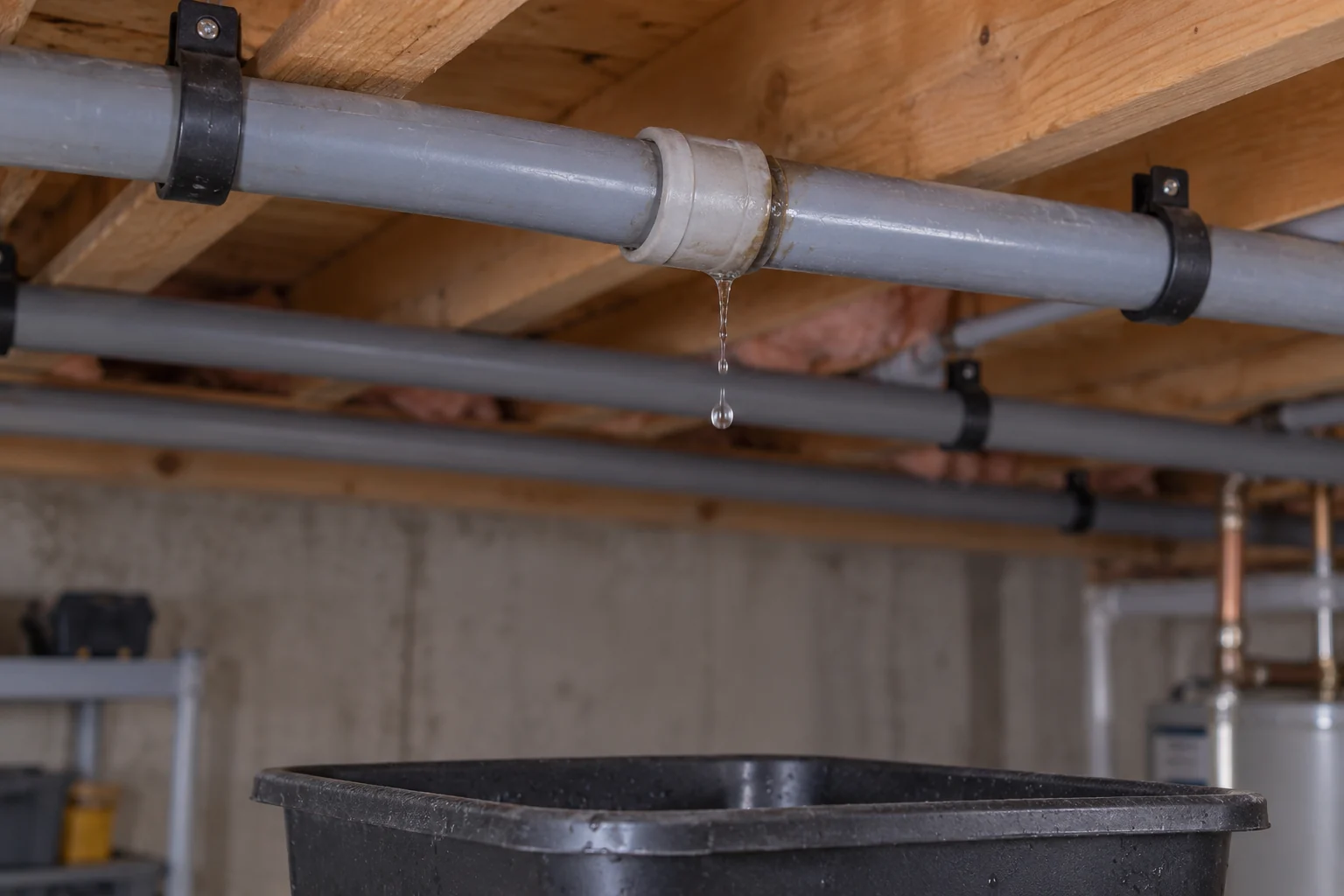
Does One Poly B Leak Mean I Must Repipe In Calgary?
One Poly B leak does not automatically mean every pipe in a Calgary home must be replaced. First establish what failed and whether inspection finds problems elsewhere. A damaged fitting, a pipe defect and a repeatedly leaking network can lead to different choices. A spot repair may control the immediate leak, while wider replacement may be considered after reviewing the installation, previous failures, access and the homeowner's plans.
Find out what actually failed
Ask the plumber to identify the leaking component rather than describing the whole installation as "bad Poly B." Was water coming from the tubing, a fitting, a connection to another material or a nearby valve? A cabinet can contain several possible sources, and water may run along one line from a different connection. A repair decision should begin with the confirmed source.
Keep a photograph of the failed part if it can be obtained safely. The contractor's record should say what was removed and what was found. It should also distinguish a visible defect from a suspected cause that needs further checking. Knowing that a pipe was wet is useful; knowing why a particular component released water is more useful when deciding how much plumbing work follows.
Stop the immediate release before choosing a long-term project
If water is spreading, the first job is to control the source and protect people. Do not postpone that job while gathering whole-house repiping quotes. A temporary restriction or local repair can create time for an informed decision, depending on the conditions. Clarify whether the intervention is temporary, which fixtures remain unavailable and who may restore their use.
Our Poly B leak repair service in Calgary can assess the immediate problem. Where a larger release affects walls or ceilings, the pipe leak response guide helps organize the household's first steps. Repairs to the source and drying or restoring the affected building materials are separate jobs. A working faucet afterward does not show that all wet materials are dry.
Separate one failure from a pattern of failures
A previous repair record can change the discussion. Several independently confirmed leaks at different locations deserve a different review from one damaged joint beside a recent renovation. Record dates, rooms and the component repaired each time. Avoid combining unrelated faucet, drain and supply-pipe incidents into one count of supposed Poly B failures.
Ask whether accessible inspection finds other cracking, leaking joints or installation concerns. A contractor should state the areas checked and any concealed areas not inspected. An absence of visible leaks cannot guarantee the future condition of every pipe, but it also does not justify pretending hidden damage has been confirmed. The decision should reflect both evidence and uncertainty without turning either into a certainty claim.
Compare the repair boundary with the replacement boundary
| Question | Spot repair | Wider replacement |
|---|---|---|
| What is included? | The identified failed section and stated connections. | The specific supply routes named in the quote. |
| What remains? | Other existing pipe and fittings outside the repair. | Any service line, common supply or excluded branch stated separately. |
| What access is needed? | Access sufficient to reach and repair the source. | Openings and fixture access along the agreed replacement routes. |
| What is the household impact? | Restrictions associated with the local work. | The contractor's stated water interruptions and room access plan. |
The words "full repipe" are not a substitute for a scope. Ask whether the quote covers every interior water line, whether an underground service is separate and what happens at inaccessible areas. Compare written boundaries so a small quote is not judged against a much larger one as though both offer the same work. Use the actual findings when comparing a Poly B spot repair with repiping, rather than treating one failure as proof of a house-wide pattern.
Consider planned renovations and practical access
An upcoming bathroom or basement renovation may make certain routes easier to reach. That can be relevant to timing, but it does not create a universal rule that every leak requires a renovation. Ask whether the proposed plumbing work can be coordinated with already planned openings and whether waiting leaves an unresolved leaking component.
For a finished home, clarify who moves fixtures, opens walls and repairs finishes. Ask about access to kitchens, bathrooms and occupied rooms, and how the contractor will leave the house between work periods. In shared buildings, common water systems and permissions can change what one owner is authorized to replace. Discuss those boundaries with management before approving work affecting other occupants.
Keep local advice and policy requirements in their proper roles
Calgary's home maintenance guidance includes information about Poly B and does not prescribe automatic replacement merely because problem-free piping is present. An actual leak calls for investigation, but one incident still needs its own findings. Ask the contractor to explain how those findings support the recommendation for your property.
Your insurer may have separate policy or underwriting requirements. Obtain those directly from the insurer and provide accurate repair records. Do not assume that replacing one section changes the status of all remaining piping, or that a repipe guarantees a future claim outcome. Insurance requirements can inform your decision without replacing the plumbing diagnosis or the written construction scope.
Ask these questions before approving the next step
- Which part failed, and what evidence identifies it as the source?
- What did inspection establish elsewhere, and which routes remain concealed?
- Does the immediate repair leave any fixture or system restricted?
- Which remaining components motivate the recommendation for more work?
- What exactly does each option include and exclude?
- Who handles permits, openings and finish repairs when they are required?
- What records will I receive showing the completed scope?
If a quote uses an allowance, ask what condition could change it and how approval will be obtained. Avoid comparing only the headline amount. A homeowner needs to understand what the number buys, where uncertainty remains and whether additional access, restoration or another contractor's work is outside it.
Make a documented decision instead of a fear-based decision
You may decide that a confirmed local repair is the appropriate immediate step, or that a broader planned replacement better fits repeated failures and renovation plans. The useful distinction is why the choice fits the evidence. Keep the repair findings, photographs and estimates so the next contractor can see what happened rather than start from a general label.
After work, record the actual replaced routes and any remaining materials. Report new wetness or another leak promptly instead of assuming the previous visit covered that location. A clear record supports future maintenance and honest discussions with insurers or buyers. One failure starts a decision process; it does not, by itself, answer every question about the rest of a Calgary home's water supply.