Should I Shut Off Water For A Ceiling Leak In Calgary?
If a ceiling is leaking in Calgary, shutting off a safely accessible working indoor water supply may reduce a plumbing supply leak. It will not resolve every possible ceiling leak, including roof entry or retained water draining from materials. Stay away from sagging finishes and wet electrical fittings, and arrange assessment rather than standing beneath the stain to investigate. Water approaching a panel changes who should respond; read the steps for water near an electrical panel.
Treat the ceiling condition as part of the emergency
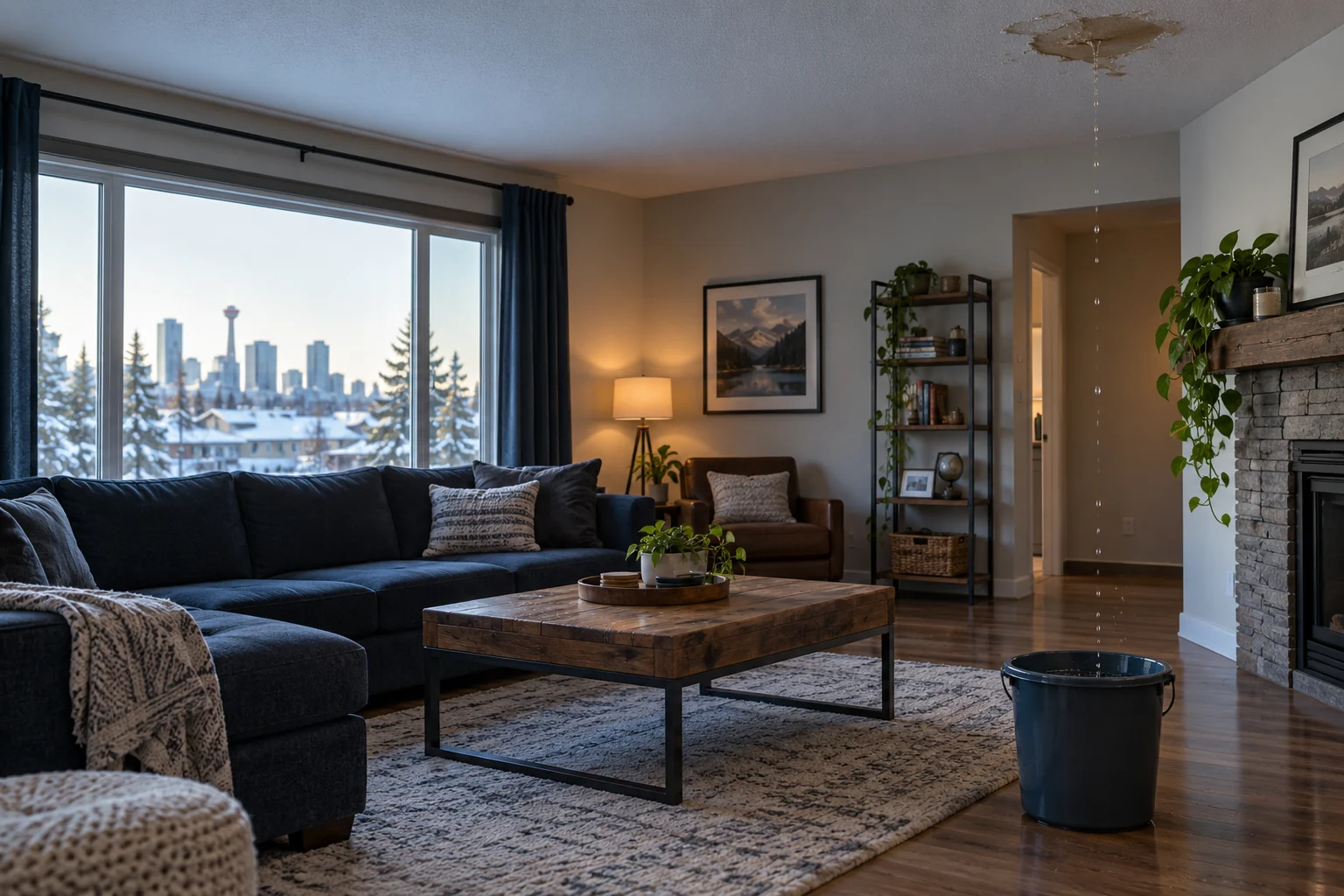
Look from a safe position for bulging paint, sagging board, active dripping or water near a light fitting. Keep people out of the affected area if the ceiling appears unstable. Do not poke a hole to drain it, remove the light cover or reach above the ceiling. Those actions can release collected water or expose hazards that are not visible from the room below.
A container may catch a drip only where it can be placed without standing beneath compromised finishes. It does not make the overhead area safe or reveal the extent of wet materials. The first decision concerns access and people, not saving every item in the room.
Consider the source without assuming it
A stain below a bathroom can involve a supply pipe, a fixture connection or drainage that leaks during use. Water may also travel along framing before appearing away from its source. A leak after rainfall or snowmelt may need a different building assessment. Give the plumber the timing and recent activity rather than stating that the nearest fixture must be responsible.
If water appears only when the shower runs, stop using that shower. If water continues with all fixtures idle, a supply source becomes one possibility. Calgary leak detection can help assess a concealed plumbing problem instead of relying on the stain location alone.
Use a known shutoff only when the route is safe
A working indoor main can reduce incoming water feeding a broken pipe. It should not require walking through standing water, reaching past electrical equipment or going beneath the damaged ceiling. If safe access is unavailable, explain that limitation when calling for help. An immediate threat to a person requires an emergency safety response.
After a valve is closed, water already collected in pipes or materials can continue dripping. Note whether the rate changes. Do not reopen the valve repeatedly or force a stiff handle because the ceiling has not stopped dripping instantly.
Keep electrical assessment separate
Water at a ceiling light or nearby electrical fitting should not be treated as ordinary damp drywall. Do not touch wet switches or equipment and do not enter a hazardous area to operate the panel. Tell the responding professionals where the water and electrical components are in relation to one another.
Alberta's flood cleanup guidance explains the need for appropriate assessment of wet electrical systems. Closing a plumbing valve does not establish that a wet circuit or fixture is safe to use.
Prepare information for a concealed repair
Describe the room above, when the water began, whether a shower, washing machine or other fixture was running, and what changed after use stopped. Mention whether the building has another occupied suite above. Access permission and shared plumbing can affect what can be inspected without disturbing unrelated spaces.
For water leak repair, ask how the source will be assessed and what access may be necessary. Do not cut open the ceiling before the appropriate assessment simply to speed the visit. Record the visible location and current conditions instead.
Plan what happens after the source is repaired
The ceiling may need separate evaluation, drying or reinstatement after the plumbing work. A repaired pipe does not show that all concealed materials are dry, and a stain becoming less noticeable does not establish structural or electrical safety. Ask what observations or limitations should be passed to the next professional.
Our burst pipe response guide explains why source control and material assessment are separate stages. Keep photographs taken safely, repair details and the sequence of events so follow-up work starts with useful information rather than a guessed explanation.
A ceiling leak information checklist
- Visible condition: note a stain, active dripping, sagging board or a change around a fitting. Do not stand underneath unstable finishes to describe them.
- Room above: identify known fixtures or another suite without entering a private or hazardous area. The layout is context, not a confirmed source.
- Timing: say whether the change followed shower use, appliance drainage, idle time or weather. Retain uncertainty when events overlap.
- Isolation response: explain which known valve was closed and how the dripping changed. Residual water can continue moving through materials.
- Electrical proximity: mention ceiling lights or other equipment without touching them. This can affect safe access even when the original water looks clean.
- Spread: identify visible symptoms in adjacent rooms or the floor below. The amount caught in one container is not a complete incident measurement.
Why two ceiling stains can need different assessments
A stain that follows a shower may lead the plumber to assess its plumbing and related fixture arrangement. It does not establish whether a supply connection, drain route or another part of the assembly is responsible. Avoid applying sealant around the shower as a diagnosis substitute: changing a surface can obscure the original pattern without resolving a concealed source.
A stain that appears during weather may require building-envelope assessment, particularly if no use pattern or supply clue supports a plumbing fault. The timing should still be recorded carefully. Rainfall and household use can occur together, so the assessment should not dismiss one source simply because another event is easier to remember.
In both examples, the ceiling condition determines immediate access limits. Sagging finishes, wet electrical equipment or water spreading into another room need attention regardless of which source is eventually confirmed. Describe those conditions at the beginning of the call.
Ask the source assessor what the findings support and what remains outside scope. If opening a finish is proposed, clarify the purpose, location and subsequent reinstatement. The objective is to repair a confirmed source and arrange appropriate material evaluation, not merely remove the stain or assume that turning the main off resolves every possible ceiling-water problem.