Should I Replace Or Tighten A Supply Hose In Calgary?
A fixture supply hose in Calgary should be replaced rather than merely tightened when its body or integral ends are damaged, its seals or fittings cannot provide the specified connection, or inspection finds that it is unsuitable for the installation. Tightening is not a general repair for every leak. The correct choice depends on the source and the product's instructions, including the condition of the shutoff and fixture connections on either side.
Start by asking where the leak originates
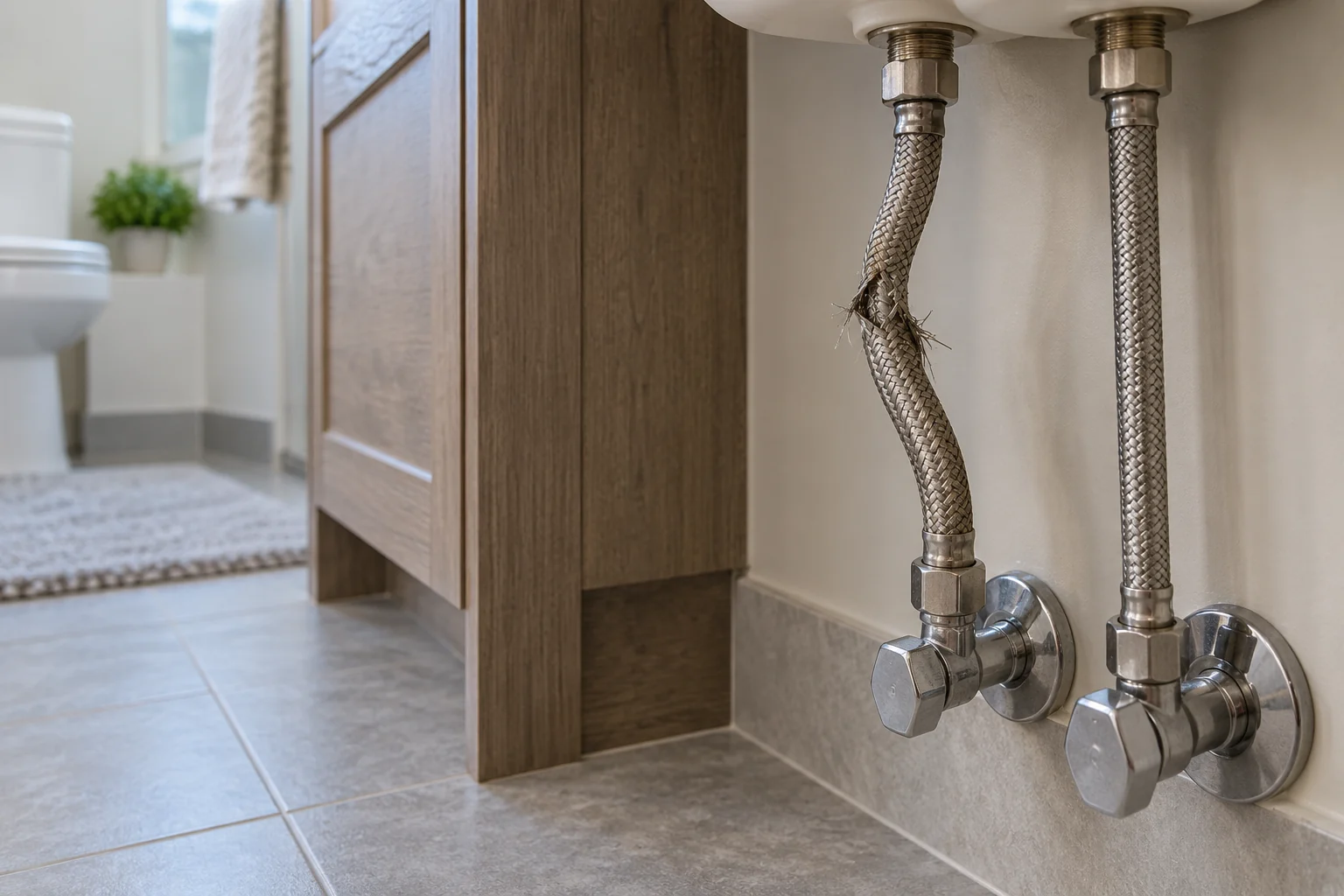
A wet connector does not always mean the connector itself failed. Water can come from a shutoff stem, a faucet inlet, the fixture body or a drain above it. The repair should follow the confirmed source. Replacing a hose without checking those adjoining parts can leave the homeowner with the same wet cabinet and no explanation of why the first repair did not work. A sudden braided supply-hose leak can keep releasing water even when the faucet handle is off.
Describe whether water appears with the fixture unused or only while it operates. Note the first visible wet point from a safe position, and keep a photograph if possible. Do not loosen the connection to investigate while the water supply is on. If the route is concealed or access is cramped, tell the plumber rather than pulling components out to make the diagnosis easier.
Recognize problems that extra tightening cannot solve
Water escaping through a hose body, damaged braid or a cracked end assembly is not addressed by turning a connection nut. A kinked or stretched connector may also need replacement with a suitable arrangement rather than being forced into another bend. Ask what the inspection found and whether that finding explains the actual leak.
A seal can be damaged or incompatible even when the surrounding metal looks sound. Threads on an adjoining component may also be damaged. Those conditions need the correct repair or replacement, not an assumption that every drip is a loose nut. If a connector repeatedly leaks after adjustments, stop the cycle and have the assembly checked. An apparently dry joint immediately after manipulation is not a reliable long-term diagnosis.
Follow instructions for the actual connector design
Different supply connections can seal in different ways. That affects whether a tool, sealant or particular tightening method is permitted. Manufacturer installation instructions should be matched to the installed product rather than borrowed from a similar-looking hose. Resources such as Watts product support and installation guides can help locate instructions for that manufacturer's products.
Do not assume that tape on threads will repair a connection that seals with a washer or another internal element. Likewise, more force can damage a part instead of stopping the leak. Keep any accessible product label or packaging, but do not delay source control while searching for it. A plumber can establish which component is installed and what parts are suitable for the repair.
Use this replacement discussion checklist
- Source: was the connector, valve, fixture or another pipe identified as leaking?
- Body condition: is there damage, abrasion, an unsuitable bend or a leak away from the nuts?
- Ends: are integral fittings, seals or adjoining threads damaged?
- Fit: does the proposed replacement match the fixture and intended service?
- Routing: can it be installed without stretching, kinking or interference from stored items?
- Isolation: does the fixture shutoff work properly, or does it need its own repair?
- Verification: what checks will be done before the supply returns to ordinary use?
These questions help compare a short proposal to "tighten the line" with one that identifies and replaces a failed component. They are not instructions for an untrained homeowner to dismantle the assembly. The point is to understand what the contractor is repairing and why that work fits the observed problem.
Do not use one age rule for every household hose
The product, service conditions and manufacturer recommendations matter when discussing replacement timing. A general online interval cannot identify the age, quality or installation of the hose currently beneath your sink. Ask for the instructions or recommendation that applies to the actual connector. If its age and history are unknown, record that rather than inventing an installation date.
Visible condition also has limits: a clean outer braid does not show every internal seal or tube. Routine observation is useful for finding new water, but it is not a pressure test or guarantee against failure. If the plumber recommends proactive replacement, ask what supports that advice for your installation and which connectors are included. A proposal should distinguish a failed part from another part being changed preventively.
Control an active leak before comparing options
A supply connector may remain pressurized even when the faucet or appliance is not operating. A known safely reachable fixture shutoff can be relevant, but do not force it or approach it through hazardous water. If it does not control the release, report that and seek help. Calgary's home plumbing guidance explains the importance of controlling the appropriate water source.
For Calgary supply-line repairs, tell the contractor whether the water continues and what control was used. In a shared building, involve management for common services and access. Do not disconnect a hose just because a handle appears closed; the actual isolation and remaining water need to be dealt with before work begins.
Include the valve and fixture boundary in the repair record
Replacing the connector alone does not address an ineffective shutoff or a damaged fixture inlet. Ask whether those parts were checked and whether anything remains outside the work. If more than one component is replaced, record each one. That prevents a later leak beside the same sink from being misidentified as a failure of the new hose.
The pipe leak response guide can help if water has reached flooring or rooms below. Ask separately about wet cabinet materials and concealed spaces. A source repair and building drying have different scopes. If the estimate excludes restoration or moisture inspection, make sure the homeowner understands who will handle those needs rather than assuming they are covered by the hose replacement.
Leave the repaired installation accessible
Once the repair is complete, keep the shutoff reachable and avoid storing objects against the connector. A hose should not become the support for a shelf or the obstacle that gets pushed aside when cleaning. Ask about any required clearance or routing limitation associated with the replacement. Do not alter its bend or attachment to make room in the cabinet afterward.
Retain the product and repair information and report new wetness promptly. A useful repair leaves you knowing which component failed, what was installed and what checks were performed. Tightening can be appropriate only when it fits the diagnosed connection and its instructions. It should never become a substitute for replacing a damaged assembly or understanding where the water is actually coming from.