Why Do Several Drains Clog At The Same Time In Calgary?
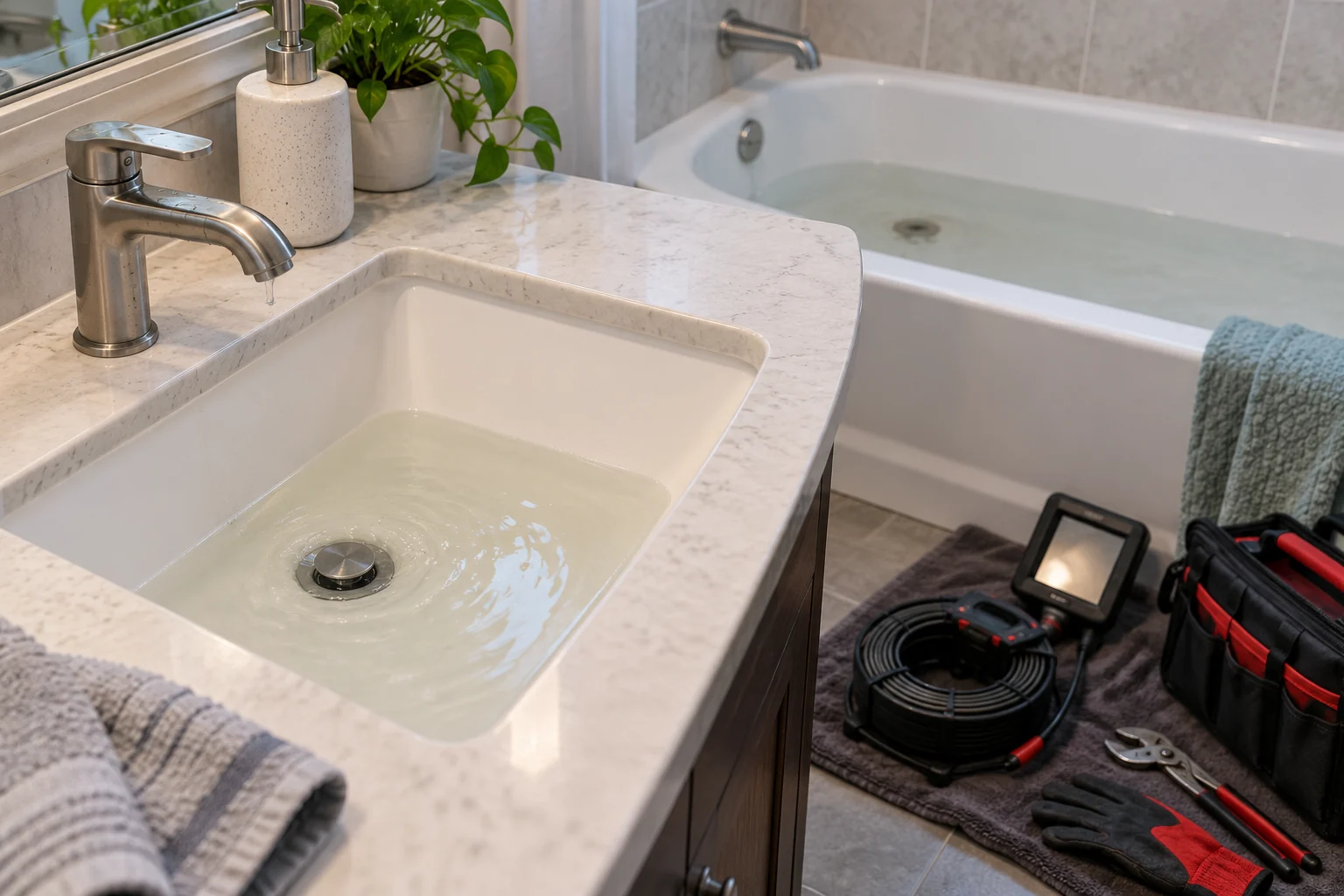
Several drains can clog at the same time in Calgary when they share a restricted drainage route or when a wider sewer problem affects their discharge. That does not mean every fixture has a separate clog. The location and timing of returning water help a plumber investigate the affected route. Stop connected use if wastewater is backing up, report all affected fixtures and avoid repeated test flushes or opening cleanouts yourself.
Think about the drainage route beyond the fixture
Water leaves a sink or toilet through a connected drainage system, not through an independent route all the way to the street in every case. Several fixtures can join downstream. An obstruction after that connection can affect more than one of them. A sink that seemed normal yesterday may become slow today as the shared route's available capacity changes.
The homeowner does not need to draw the whole system to report that pattern. State which fixtures have already changed and what happened when water was used. A plumber can interpret those observations with the actual installation. Do not infer the blockage's distance or material from the number of affected drains alone. Similar visible symptoms can come from different problems and require different work.
Pay attention to water appearing in a lower fixture
If using an upstairs fixture causes water to appear in a basement shower or floor drain, include that detail in the first call. It can be particularly useful because it describes how the connected system is behaving. Stop the activity that caused it rather than repeating the sequence to confirm the effect. Water returning through a drain should be kept away from people and household contents where possible without entering the contaminated area. Water returning through a basement floor drain gives the contractor a more useful clue than the slowest sink alone.
Gurgling or slow drainage can also be worth reporting, but sound alone does not diagnose an obstruction or ventilation problem. Explain the sound alongside the water behaviour and timing. A brief gurgle in one fixture is different from several drains becoming unusable. The combination of symptoms matters more than labelling every noise a main-sewer failure.
Rule out neither public nor private causes from one clue
A wider drainage event may involve private plumbing or City infrastructure. Calgary's sewage backup guidance describes reporting to 311 and how the issue is triaged. Provide the actual address and symptoms. Do not assume heavy rain proves the City sewer caused the incident, or that a blocked kitchen sink establishes a public problem.
For an internal concern, Calgary emergency drain cleaning can investigate the private system. Keep any 311 instructions or report number and share them with the plumber. In a shared building, management should also know which units or common spaces have reported symptoms. A neighbour's similar problem is relevant information, not proof of the source location.
Prepare a fixture-by-fixture report
| Observation | Useful detail to provide |
|---|---|
| Two fixtures drain slowly | Identify the rooms and when each change was first noticed. |
| Water returns in a lower drain | Say which activity occurred immediately before the return. |
| Appliance use affects a fixture | Identify the appliance cycle and the drain where water appeared. |
| Problem follows earlier clearing | Provide the previous report and what work was performed. |
| Another unit reports symptoms | Give management the reported locations without entering that unit. |
Add recent renovations, known cleanout locations and any chemicals used. If you are uncertain about a connection, say "the washing machine was running when the floor drain rose" rather than "the laundry pipe is broken." The first statement is an observation the contractor can use. The second is a diagnosis that may direct attention away from the actual problem.
Stop adding water while a backup is active
Tell other occupants not to flush toilets, start washing machines, drain baths or run dishwashers into the affected system. Do not assume a different bathroom is independent if several drains have already changed. Ask the plumber which fixtures can be used, based on the actual system. The restriction needs to be clear enough that someone returning home does not start a cycle without knowing the problem.
If an appliance is already running, ask about stopping it through its normal controls without handling wet electrical equipment. Do not pull a plug in a wet area or move the machine to reach an unfamiliar valve. Explain the ongoing discharge in the call. Turning off a building's drinking-water supply is not the same as removing wastewater already in the drainage route or preventing an unrelated external backup.
Leave cleanout caps and chemicals out of the experiment
A cleanout provides access for professional work; during a backup it can also be a point where wastewater escapes if opened. Identify its location where safely visible, but leave the cap in place. If it is hidden beneath a finished floor or behind storage, report the obstruction. A contractor can plan access and request the necessary permission rather than discovering it only after arrival.
Avoid adding drain cleaner to several fixtures in the hope that one reaches the obstruction. If a product was already used, provide its name and location. Do not combine it with another cleaner or try to neutralize it. The sewer backup response guide explains why protecting people and stopping connected use come before improvised clearing work.
Ask what clearing establishes and what it does not
When the drains run again, ask the contractor to explain the work and findings. Clearing an obstruction may restore flow without identifying why it formed. If the problem recurs, further investigation may be appropriate. Ask what would be checked and how the result would affect the repair choice rather than assuming a camera inspection, hydro jetting or excavation is always required.
A camera result is also only as useful as the route actually inspected and the conditions that allowed visibility. Keep the location, limitations and report where supplied. Distinguish a confirmed pipe defect from material removed during clearing. The next decision should follow the evidence, not a blanket claim that multiple slow drains prove the sewer line needs replacement.
Keep a useful maintenance history
- Keep the previous clearing date and the route the contractor worked on.
- Save any inspection report with its visibility or access limitations.
- Record the specific warning signs that should trigger another call.
- Identify who will handle further investigation if the same symptoms return.
Record which fixtures were affected, the timing, any City contact and the contractor's findings. If maintenance is recommended, ask what it addresses and what interval or warning sign should trigger another visit. Keep access points reachable in ordinary conditions and follow appropriate disposal practices. Preventive work should fit the diagnosed problem rather than become another recurring task with no stated purpose.
If the symptoms return, compare the new pattern with the earlier one. Are the same low fixtures affected? Does the return follow the same appliance discharge? Is the water continuing when nobody uses plumbing? Report those changes without running another test. For Calgary homes with several affected drains, the connected pattern is valuable information that helps a plumber investigate beyond the first fixture that looks blocked.